
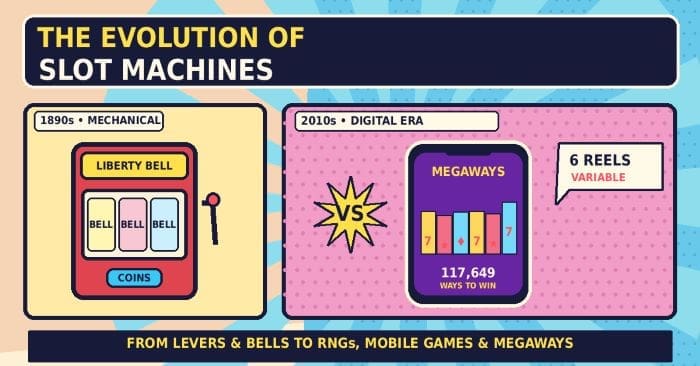
I’m starting this with a statement that shows that the experience of pulling a lever on an old-style Mills machine is not just physically rewarding, it also provides a connection to the history. The lever resists you, the spring winds up, and the three drums come to rest one at a time, clack-clack-clack. Open Bonanza on your mobile phone and tap on the screen. There are Six reels, each is a different length, and you are informed by the game that there are 64,827 ways to win in the last spin; the next spin, it’s 2,304.
It’s approximately 130 years since these two experiences occurred and the underlying concept remained constant: place money in a machine and wait to see what appears. However, everything else changed. Slot machine history is largely the story of engineers and designers continuing to develop new ways to maintain the excitement and freshness of that one basic cycle, while government agencies continue to struggle to regulate the developments.
Slot machines evolution (from saloon novelty in San Francisco during the 1890s to software studios today)
Before the slot machine existed: poker in a box. The first slot machine wasn’t truly a slot machine. Sittman and Pitt constructed a coin-operated gaming machine with five drums containing fifty playing cards in 1891. Insert a nickel, pull the lever, and the drums turn to reveal a poker hand.
No payout was provided automatically. This machine knew nothing about a “full house.” If you received a favorable poker hand, you needed to inform the bartender and he would provide you with payment in the form of either a complimentary beverage or a cigarette; in some cases, you may receive a couple of beers for a pair of kings and a pack of cigars for a royal flush. They commonly removed the ten of spades and jack of hearts from the drums, thus significantly reducing your opportunity to receive a royal flush. Therefore, the house advantage existed since inception. It was created with a pair of tweezers.
Poker machines proliferated throughout bars in New York and other locations, and demonstrated to operators that customers would willingly insert coins into a machine in anticipation of receiving a prize. These machines lacked a method of paying winners without human intervention. Fifty cards on five drums create numerous possibilities such that simple clockwork cannot interpret.
Charles Fey and the Liberty Bell: first true slot
Charles Fey, born in Germany and employed as a mechanic in San Francisco, recognized that the poker machines previously developed lacked simplicity, not intelligence. Rather than use five drums with 50 cards, he opted to use three reels and five symbols: horseshoes, diamonds, spades, hearts, and a broken Liberty Bell. Since there were so few combinations, it was feasible for a mechanical unit to identify the winning combination and dispense winnings accordingly.
The period associated with the creation of the Liberty Bell slot machine is somewhat ambiguous. Historical sources indicate anywhere from 1887 to 1899. Most scholars agree that it was created somewhere within the middle to late 1890s (approximately 1895 to 1898).
Liberty Bell had three reels and five symbols. Three Liberty Bells yielded the top award of ten nickels ($0.50), which was considerable for a saloon patron. All smaller awards were lower, and upon landing Three bells, a coin tray filled automatically.
Automatic payout is what makes Liberty Bell so significant. It is considered by many to be the first slot machine because it could operate independently of human oversight. An establishment owner could install one in his saloon and allow patrons to gamble. The Three-reel configuration, single payline, and fixed paytable on the front of the machine were adopted by most manufacturers for nearly the entire twentieth century.
Mechanical era: springs, gears & copycats
If you’ve ever looked inside an older style mechanical slot machine, it’s quite fascinating. Upon releasing the lever, a spring is wound-up and releases the reels. Brakes mechanically halt each drum sequentially as they rotate. Notched disks located behind each reel indicate what symbols appear once the drums cease rotating. When the notches align to signal a win, an automated payout mechanism releases the correct amount of coins from a cylindrical container.
Physical limitations exist due to the mechanical nature of the devices. Each reel has limited stops based on its design. Initially around 10 stops per reel, manufacturers increased this limit to 20 or 22 stops per reel. Limitations of reel stops determine maximum value of a jackpot that can be offered by an operator. For example, a machine offering 10,000 coins on a 1-in-8,000 occurrence represents a losing proposition for an operator.
Classic symbols: fruit machines
Cherries, lemons, plums, etc.:
The evolution of classic symbols can be attributed to attempts to circumvent increasing restrictions on gambling as governments sought to eliminate machines from public establishments. Makers attempted to disguise their products as gum vending machines. To match flavor profiles of gums being sold, symbols representing fruit flavors appeared. A player “wins” additional gum or tokens or receives nothing at all on paper. Fruit-based themes ultimately persisted.
Origin of BAR symbol:
BAR symbol origins typically trace back to bell-fruit gum company logos. Number seven entered fray as a lucky number that distinguished itself among reels.
UK took fruit-based theme seriously, which is why slots remain known as “fruit machines“. US versions retained the original term ‘one-armed bandits’, which clearly conveyed feelings patrons had regarding levers and odds.
Money honey: electromechanical revolution
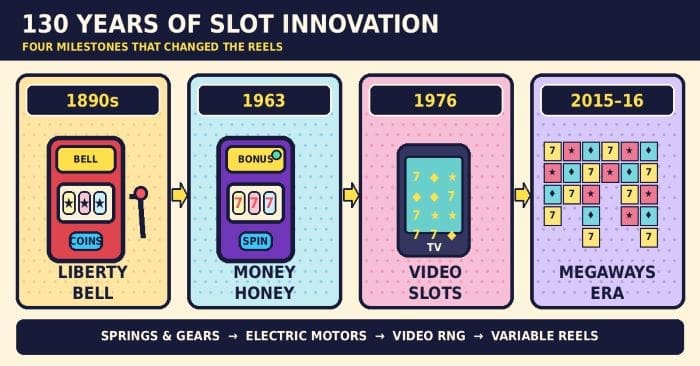
Prior to the 1963/1964 release of Money Honey by Bally Manufacturing, casinos viewed slots primarily as distractions for spouses/girlfriends of high-stakes players. After Money Honey was released, trends began to change.
Money Honey is often referred to as the first electromechanical slot machine. While it had physical reels, electric motors/solenoids performed much of the functions formerly accomplished by springs/gears. The most prominent aspect was the bottomless hopper – a substantial coin reservoir that could automatically dispense up to 500 coins as payouts.
Previous versions‘ inability to store sufficient amounts of coins resulted in attendants providing hand-outs when larger prizes were awarded. Money honey dumped coins directly into tray, making loud noises. Those noises represent marketing; every casino on the Strip learned it.
Electromechanical slots utilized contact switches connected via electrical connections to identify reel positions and circuitry electronics to calculate winnings. This facilitated multi-coin bets, expanded paytables/bonuses, and visual/audio stimulation when winning occurred.
The lever remained as decoration for many subsequent designs; however, for many others it merely actuated a switch; buttons performed a similar function for even more recent models.
Why does money honey matter?
Because it severed the relationship between payout size and mechanical capacity. With the ability to pay hundreds of coins automatically without assistance from attendants, designers were able to create larger potential prizes, which attracted gamblers away from tables. Slots started long journey towards establishing themselves as primary source of revenue for casinos.
Video slots: reels become screens
In 1976, Fortune Coin Co., Inc. (Las Vegas) placed a modified 19-inch Sony Trinitron TV in a slot cabinet. Images on screen replaced actual reels. Machine premiered at Las Vegas Hilton Hotel Casino; initially, skeptics from clientele who were wary of what they could not visually confirm spinning; after approvals from the Nevada gaming commission/board, Fortune Coin was purchased by IGT in 1978.
What led early online slots running on Adobe Flash (desktop PCs) to transition towards utilizing HTML5 (mobile devices) between approximately 2012 and 2016?
Adobe Flash reached end-of-life status at the close of 2020; by then, most developers had migrated towards newer technologies years prior.
Future of slot machines:
Likely will resemble past: someone develops innovative means of varying loop; everyone follows suit. Features like hold & win; cash collect mechanisms; cluster pays; bonus-heavy games like Gates of Olympus or Big Bass Bonanza illustrate ongoing innovation in studio designs. Cabinets (casino floors) are essentially enormous curved displays featuring physical reels occasionally included as nostalgic element; online growth emphasizes developing games centered on features rather than pure spin count.
However, strip away visuals/mathematics; the fundamental remains what Charles Fey created in his San Francisco workshop: place money in a slot machine; observe symbols; hope for three bells.
Frequently Asked Questions
Who developed the first slot machine?
Charles Fey is credited with creating the first true slot machine – Liberty Bell. Prior to Liberty Bell existed Sittman & pitt’s poker machine from 1891 that featured five drums with fifty playing cards; it was incapable of dispensing funds automatically.
What year was Liberty Bell created?
References vary between 1887 & 1899; most scholars accept the mid-to-late 1890s (approximately 1895-1898) timeframe.
How many reels/symbols were featured in Liberty Bell?
Three reels / five symbols: horseshoe diamonds spades hearts & broken liberty bell. Top prize (Three Liberty Bells) = ten nickels ($0.50), which was relatively generous for a saloon customer. Top prize winner would receive only one coin tray fill regardless of award size.
Was the first electromechanical slot released by Bally?
Yes. Bally Manufacturing introduced Money Honey circa 1963-1964.
Is the first video slot Fortune Coin’s model from 1976?
The Fortune Coin model from 1976 was the first commercially available video slot machine. It utilized a modified Sony Trinitron TV, displaying reel images instead of actual reels.
What is the first progressive jackpot slot introduced?
Megabucks by IGT, circa 1986 is first progressive jackpot slot in widespread commercial distribution; it achieved the highest jackpot in recorded history ($39.7 million) circa 2003 at Excalibur Casino in Las Vegas